1Z0-831 exam review – OCP Java SE 25 Developer
I recently took and passed the Oracle Java SE 25 Developer Professional (1Z0-831) exam. Having previously passed the Java SE 7, 8, 11 and 17 certifications, I thought I'd share my experience once again, including how this exam compares with previous versions, the resources I used, and some lessons learnt along the way.
Java has changed considerably since I first started taking these exams, and so has the way we develop software. With AI now capable of generating entire classes, tests and even applications, you might wonder whether a programming certification is still worth pursuing. I'll come back to that later.
📋 Notes on the exam
Unlike the old upgrade exams, which focused on changes introduced since a previous Java version, the Java SE 25 certification covers a broad range of the language.
That means revisiting familiar topics such as inheritance, collections, generics and exception handling, alongside newer features including stream gatherers, scoped values, flexible constructor bodies and the latest additions to the Java APIs.
The challenge isn't necessarily understanding what a feature does. It's understanding precisely how it behaves, particularly when combined with other language features.
You might be perfectly comfortable using streams in your day-to-day work, for example, but that doesn't necessarily mean you'll immediately spot the implications of a parallel stream, an overloaded method reference or a particular collector.
As with previous certifications, the exam tests aspects of Java that you might rarely encounter in normal development. Some questions feel rather artificial, but they do force you to understand the language beyond its most common use cases.
📚 Revision
I approached this exam using a combination of study guides, practice exams, ChatGPT and runnable Java examples.
My initial focus was refreshing my knowledge of the language, particularly areas I don't regularly use. I then concentrated on Java 25-specific material before moving towards mock exams and reviewing the results.
I used the following resources.
OCP Oracle Certified Professional Java SE 21 Developer Study Guide – 3/5 ⭐⭐⭐
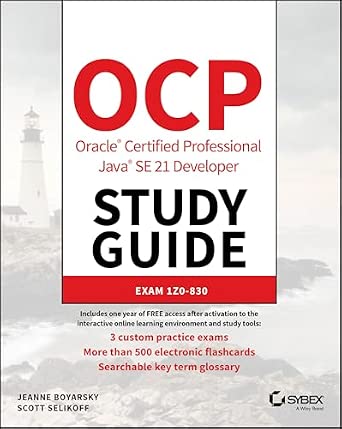
By Scott Selikoff and Jeanne Boyarsky.
I've used several editions of these authors' books over the years and have always appreciated their conversational writing style. They make complicated subjects approachable, with plenty of examples and questions to reinforce the material.
However, I felt this edition hadn't moved on significantly from the Java SE 17 book.
That's not necessarily a criticism of the authors, as much of the language remains the same. Nevertheless, I felt the certification questions had become more demanding in their treatment of edge cases and combinations of language features.
The book remains a good foundation, particularly if you need to refresh the core APIs, streams, concurrency, modules and other established topics. However, I wouldn't rely on it alone when preparing for Java SE 25.
It's worth mentioning that I haven't taken the Java SE 21 exam, so my comparison is with the Java 17 material and my experience of the Java 25 exam.
OCP Java 25 Exam Fundamentals – 4/5 ⭐⭐⭐⭐
By Hanumant Deshmukh.
This was a much more targeted resource for the exam I was preparing for.
Whereas the Java 21 book provided a broad foundation, this book helped identify newer features, relevant APIs and details that might otherwise have escaped my attention.
The suggested study plan was around two hours per night for six months. Personally, I worked through all the chapters apart from the introductory Kickstarter chapter in approximately three weeks.
I didn't complete the end-of-chapter exercises, choosing instead to spend that time on practice exams and investigating questions I got wrong. That was largely a time-management decision rather than a reflection on the exercises themselves.
The advantage of this approach was that I could cover the material relatively quickly and identify weaknesses through testing. The disadvantage is that reading alone can create a false sense of understanding. It's easy to recognise a concept on the page without being able to apply it to an unfamiliar question.
This book complemented the Java 21 material well and felt more closely aligned with the certification.
Enthuware Java SE 25 Practice Exams – 5/5 ⭐⭐⭐⭐⭐
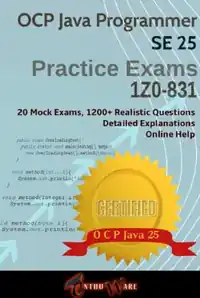
Enthuware OCP Java Programmer SE 25 Practice Exams
These were easily my most valuable practice resource.
The questions were very relevant to the exam, both in terms of subject matter and difficulty. They also exposed areas that weren't covered in sufficient depth by the Java 21 study guide.
The practice exams provided a useful indication of my progress as I worked through them. However, the greatest benefit wasn't the score at the end of each test. It was the time spent reviewing the answers afterwards.
For every incorrect answer, I wanted to understand why my reasoning was wrong. Sometimes I'd misunderstood a rule. Other times I'd overlooked something subtle, such as the declared type of a reference, a checked exception, method overload resolution or the ordering guarantees of a stream.
I also reviewed questions I'd answered correctly but wasn't entirely confident about.
The downside is that this process can be time-consuming. A practice exam might take a couple of hours, but reviewing it properly could take considerably longer.
Nevertheless, I found the Enthuware questions very similar to the real exam in length, difficulty and subject matter. I'd strongly recommend them.
Other practice exams
I also used some Udemy practice tests.
These were useful for additional exposure to questions, although the quality varied. Some contained poorly formatted code, questionable answers or explanations that didn't adequately justify the result.
Others were considerably more challenging and provided useful practice with complicated language behaviour.
The important lesson here is not to assume every practice question is correct simply because it appears in a paid course.
If an explanation doesn't make sense, verify it against the Java documentation or run the code yourself.
🧠 Using ChatGPT to review questions
This was probably the biggest change to my revision process compared with previous certifications.
After completing a practice exam, I'd work through the questions with ChatGPT, explaining my reasoning and asking it to challenge my understanding.
Rather than simply asking for the correct answer, I found it more useful to investigate questions such as:
- Why does this overload get selected rather than another?
- Would the result change if the reference type were different?
- Does this compile, and if not, which rule prevents it?
- Is the behaviour guaranteed, or merely one possible outcome?
- What would happen if the stream were parallel instead of sequential?
This was particularly useful for concurrency, streams, generics and some of the more obscure Java APIs.
Occasionally, ChatGPT would get an answer wrong or overlook a detail itself. That was actually a useful reminder that AI-generated explanations need to be checked, just like AI-generated code.
When in doubt, I'd write a small example and run it in my IDE.
This combination of discussion, experimentation and referring back to the documentation was where I felt my understanding improved most.
⏱️ Taking the exam
The Java SE 25 exam allows two hours for 50 questions, with a pass mark of 68%. That means you can answer 16 questions incorrectly and still pass.
Compared with the 90 minutes available for the Java SE 17 exam, you might expect the additional half-hour to make things more comfortable. I certainly did, but two hours can still be tight.
Some questions contain 30–50 lines of Java code, followed by six or more possible answers, each potentially containing another 15–20 lines. Others involve complicated loops where you need to track the value of several variables through each iteration.
There are also questions with as many as ten answer options, which can look daunting at first.
My advice is to be strict with your time.
If you encounter an enormous question, give it a quick scan. Sometimes the code looks intimidating but the actual question is relatively straightforward. If it's clearly going to require several minutes of analysis, mark it and move on.
Remember, you can afford 16 incorrect answers. Don't sacrifice several straightforward questions trying to solve one particularly difficult example.
I approached the exam by collecting the quicker wins first, then returning to the longer, more complicated questions once I'd worked through the paper.
After tackling those, I revisited questions I'd answered but flagged because I wasn't entirely confident. That's when my time ran out.
So although two hours sounds generous, it certainly doesn't feel that way if you spend too long on the wrong questions.
💡 A few practical tips
Don't assume long code means a difficult question. Some examples contain a lot of boilerplate, such as record or POJO declarations, which you can often skim. Of course, if the question is specifically testing record construction or class design, you'll need to pay closer attention.
Look at the possible answers early. If compilation failure isn't an option, that can be a useful clue about what the question is testing, although it doesn't guarantee the code compiles. If compilation failure is an option, watch carefully for invalid method calls, incompatible types and other compilation issues.
Follow the execution path. Start with the main() method and work through the code. If you finish without having examined a section that appears relevant, ask yourself why. Have you overlooked a method call or misunderstood the control flow?
Use the drawing tool. The exam provides a drawing facility. It's a little clunky, but it can help with questions involving loops, variable changes and complicated execution paths. Sometimes drawing the flow, or even quietly reading it through to yourself, helps make sense of what's happening.
Don't let one question affect the next. Personally, I can get into a bit of a funk when I'm struggling with a difficult question. It's important to recognise that and move on. Treat each question as a fresh challenge.
I had one question where returning to it later made all the difference. I'd overlooked a break statement associated with a label, which completely changed the output. With a fresh perspective, the answer became much clearer.
Sometimes stepping away from a question is the best thing you can do.
🎯 Exam difficulty
I found Java SE 25 harder than Java SE 17, although not necessarily because the subject matter itself is more difficult.
Both exams cover a broad range of Java, but the style of the questions has changed.
Some Java 25 questions are considerably longer, and what they're testing isn't always immediately apparent. A single example might combine several niche language rules, requiring you to understand how they interact.
That said, not every question is difficult.
There are plenty of straightforward questions where knowing the relevant API or language rule makes the answer obvious. In some ways, the breadth of the syllabus works in your favour because it ensures a mixture of topics and difficulty levels.
It's also worth checking the current exam objectives rather than assuming everything from previous certifications remains relevant. Topics such as JDBC and some older APIs are no longer part of the syllabus, while newer language and library features have taken their place.
I wouldn't recommend trying to memorise every obscure API method. Instead, focus on understanding the underlying rules and recognising what a question is actually testing.
The hardest part is often identifying the important detail among all the surrounding code.
🤖 Is Java certification still worth it in the age of AI?
I'd say so, perhaps more than ever.
AI tools are increasingly capable of generating code, suggesting refactorings, writing tests and even implementing entire features. It's tempting to conclude that developers no longer need such detailed language knowledge when an AI assistant can produce the implementation for them.
I see it differently.
I've interviewed plenty of developers over the years who have struggled with relatively straightforward coding challenges. Some of the more difficult questions in this certification aren't far removed from those challenges, except that you're expected to solve them in a fraction of the time.
Of course, being good at certification questions doesn't automatically make someone a good software engineer. Real-world development involves architecture, collaboration, maintainability and understanding business requirements.
But I do think strong programming fundamentals are becoming increasingly important as AI takes on more of the implementation work.
The best developers using agentic coding tools won't simply be those who can write effective prompts and accept whatever code comes back.
They'll be the developers who can challenge the AI, pair program with it and improve the quality of its output.
That means recognising potential bugs, questioning assumptions, identifying concurrency issues, enforcing coding standards, choosing sensible architectural patterns and ensuring that the implementation is appropriate for the system.
AI-generated code might compile and pass its tests while still containing subtle defects or introducing unnecessary complexity.
If you don't understand the language well enough to recognise those problems, how can you confidently review or maintain the solution?
In my opinion, the future isn't about developers competing with AI to write code faster. It's about developers becoming more effective by combining their own knowledge and judgement with the capabilities of AI.
A certification doesn't prove that someone can do all of this, but it does encourage a deeper understanding of the language and provides an objective way of demonstrating some of that knowledge.
For me, that's still a worthwhile investment.
🔄 What I'd do differently
Looking back, the most effective part of my preparation was the combination of realistic mock exams and thorough reviews.
If I were preparing again, I'd probably spend less time reading material I was already familiar with and move towards targeted practice sooner.
I'd still recommend a study guide for the foundations, but I'd use the official objectives to identify gaps rather than treating every chapter as equally important.
I'd also continue writing small Java examples to investigate behaviour I didn't fully understand.
It's one thing to read that a particular method returns an int rather than a long, or that a collection doesn't guarantee ordering. It's another to see the implications for yourself.
Ultimately, I found that understanding my mistakes was more valuable than simply completing more questions.
💻 Example code and study notes
I've made my Java SE 25 notes and runnable examples available on GitHub:
Java-SE25-Exam – GitHub repository
The repository includes notes organised around the Java SE 21 study guide, a Java 25 addendum covering newer language features, and runnable examples grouped by topic.
I've also included a more detailed review of the study resources I used, including their advantages and disadvantages.
Hopefully, some of it will be useful to anyone preparing for the certification, or simply looking to refresh their Java knowledge.

No comments:
Post a Comment